
Opinion
Sponsored:Gov Otti’s Holistic Approach To Development of Abia’s Transport Sector: Land, Air and Water Transport Systems Receiving Strategic Attention


By Chinonyerem Cleverson

Abia State’s transport sector is undergoing a holistic transformation under the visionary and focused leadership of His Excellency, Dr. Alex Otti, OFR. Through deliberate investments in land, air, and water transportation, the administration is laying the foundation for an integrated transport network that will enhance mobility, stimulate economic growth, attract investments, and improve the quality of life of residents.

Having recorded remarkable achievements in road transportation, the Governor is simultaneously advancing strategic initiatives in aviation and maritime transport, positioning Abia as a major gateway for commerce, tourism and industrial development.
LAND TRANSPORTATION
Recognizing that road transportation remains the most widely used means of movement for people and goods, Governor Otti prioritized the rehabilitation and expansion of road infrastructure as the first step towards transforming the transport sector.
Road Infrastructure
The success of any land transport system depends on a functional and accessible road network. Before Governor Otti assumed office, many strategic federal and state roads that served as the economic lifelines of Abia were not accessible.Major roads such as Port Harcourt Road, Ohanku Road and several others in Aba, the commercial hub of the State, had become impassable, crippling businesses and forcing car owners to abandon their vehicles in garages and businesses to close down. Travelling from Aba to Port Harcourt through the Enugu–Port Harcourt Expressway, a journey that should ordinarily take less than an hour, sometimes lasted over 3 hours as motorists diverted through neighbouring Imo State.
Similarly, severe traffic congestion around the Abia Tower axis in Umuahia caused long delays, especially during festive periods, while poor roads and damaged bridges made travelling between Umuahia and the northern zone of the state extremely difficult.
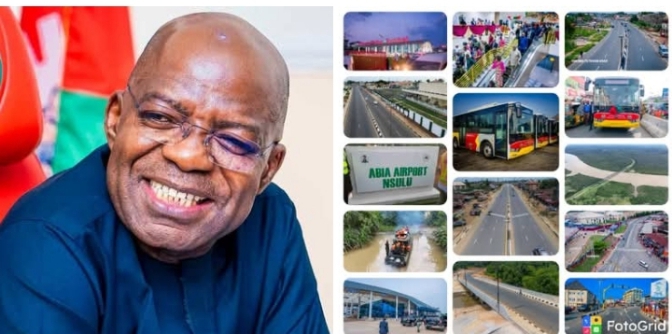
Today, these challenges are steadily disappearing. Through Governor Otti’s massive investment in road infrastructure and traffic management, over 414 roads have been constructed, reconstructed or rehabilitated across the state, with many more at different stages of construction, reconstruction and rehabilitation. As a result, movement within Abia and connecting to neighbouring states has become significantly easier, safer and faster.
Nnenna Oti Bus Terminal
Located in the heart of Umuahia, the Nnenna Oti Bus Terminal stands as one of Nigeria’s largest and most modern transport bus terminals. Named after Professor Nnenna Nnannaya Oti, former Vice-Chancellor of the Federal University of Technology, Owerri (FUTO), the terminal has transformed public transportation in the state capital. It has centralised motor park operations into a single, organised facility, improving passenger safety, reducing traffic congestion and ensuring a more efficient transport system.
Aba Bus Terminal
Construction of the Aba Bus Terminal in Osisioma is progressing rapidly. Upon completion, the terminal will eliminate the proliferation of motor parks across Aba, improve traffic flow, enhance security, and provide a modern transport hub befitting the commercial and industrial nerve centre of the State.
Modern Bus Shelters
The administration has constructed over 70 modern bus shelters across the state to improve commuter convenience and urban aesthetics. These shelters provide safe waiting areas that protect passengers from harsh weather while promoting and ensuring organised boarding and dropping off of commuters.
Traffic Management
To improve traffic control and road safety, modern traffic lights have been installed at major junctions and/or intersections across the state. These installations have significantly enhanced traffic management, reduced congestion and improved safety for motorists and pedestrians.
Green Transportation: Electric Bus Initiative
Governor Alex Otti’s administration has taken a bold step towards sustainable transportation with the introduction of electric buses into Abia State’s public transport system. Twenty electric buses are already operating successfully across Aba, Umuahia, Ohafia, and other LGAs, providing Abians with cleaner, more efficient, and environmentally friendly mobility.
To expand the initiative, an additional 20 electric buses were recently added and are set to commence operations soon, while 30 more are expected to arrive in the coming months. The electric bus programme reflects the administration’s commitment to climate-friendly policies and sustainable development.
The initiative has reduced transportation costs; improved passenger comfort; lowered carbon emissions; reduced noise pollution associated with conventional engines; promoted environmentally friendly public transportation; and provided accessibility features for persons living with disabilities.
Trailer Park at Ohiya
Plans are also underway for the construction of a modern trailer park at Ohiya in Umuahia South Local Government Area. The facility will provide an organised parking area for heavy-duty trucks, reduce indiscriminate roadside parking, improve road safety and enhance traffic management within the state capital.
ABIA AIRPORT PROJECT
Work is progressing steadily on the Abia Airport Project, a partnership between the Abia State Government and the Federal Government. While the state government is constructing the runway, the Federal Government is responsible for developing the terminal facilities.
Beyond being an airport, the project is designed as an Airport City—a modern aviation and economic hub expected to stimulate investment, tourism, logistics, and job creation, etc.
PROPOSED UKWA DEEP SEAPORT
In another landmark initiative, Governor Otti has approved the conduct of a feasibility study for the proposed seaport in Ukwa East Local Government Area. The study is being undertaken by China Harbour Engineering Company.
The proposed seaport forms part of the administration’s broader economic strategy to position Abia as a major gateway for trade, commerce, exports and industrial development, serving both the South-East and South-South regions of Nigeria. Once realised, the project will significantly enhance cargo movement, reduce logistics costs, attract industries and create thousands of direct and indirect employment opportunities.
RAIL TRANSPORTATION
I understand that the State also has plans for rail transportation. However, I would rather not speculate since I don’t have sufficient details about that aspect at the moment.
Conclusion
Governor Alex Otti’s approach to transportation goes beyond constructing roads or acquiring buses. It represents a deliberate strategy to build a modern, integrated, and sustainable transport ecosystem that supports economic development, improves connectivity, and enhances the quality of life of Abians.
Through massive investments in road infrastructure, modern transport terminals, electric buse, airport development, maritime infrastructure and future rail connectivity, the administration is laying the foundation for a transport revolution that will position Abia as one of Nigeria’s leading centres for commerce, logistics, investment and regional integration.
Indeed, the transformation of Abia’s transport sector is not merely about moving people and goods; it is about opening new pathways to prosperity, industrialisation and sustainable development.
Nwahiwe Chinonyerem Cleverson, a public affairs analyst, writes from Abia State, Nigeria.
-
 Politics1 year ago
‘Bishop Onuoha, Iyke Nwoke luring ADC members into signing a document to suspend Abia chairman’-Okwara Agwu
-

 Politics1 year ago
Ex-State Assembly aspirant, Okoh, APC executive members join ADC in Abia
-

 Politics1 year ago
2027: Southeast chieftain, Daniel Ifeanyi Okorie dumps PRP for ADC in Abia
-

 Politics1 year ago
Abia ADC announces LG chairpersons for membership registration pending harmonization
-

 Politics1 year ago
Abia ADC disciplinary committee summons national welfare secretary, Ukandu over alleged misconducts
-

 News1 year ago
Ex-presidential aspirant, Onwusoanya Ezendigbo calls for legislations banning children of public office-holders to seek education, healthcare aboard
-

 Politics11 months ago
Abia chieftain, Emeka Bahadur tasks ADC members on grassroots mobilization
-

 Politics11 months ago
Stalwart, Emeka Bahadur welcomes ADC NWC to Abia on One-day leadership summit