
Opinion
HON. PRINCE EMEKA NWACHUKWU: A COLOSSUS OF INTELLECT, PUBLIC SERVICE, POLITICAL ORGANIZATION, AND OHUHU NATIONALISM

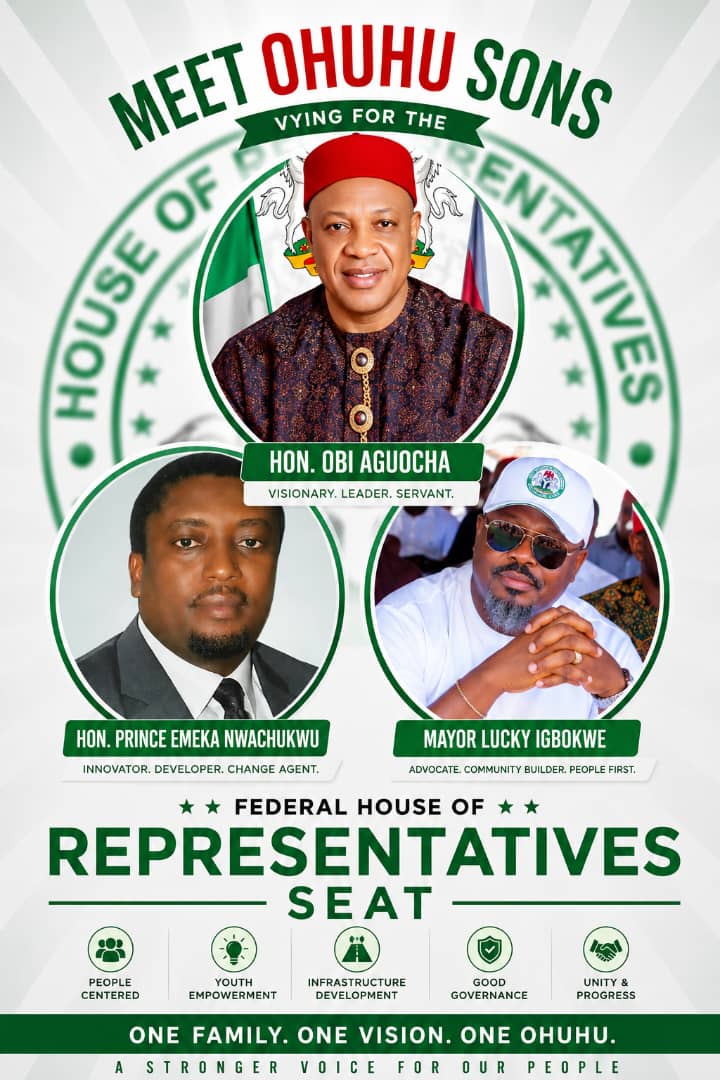

In the contemporary political and sociocultural history of Ohuhu land and Abia State, few personalities command the depth of experience, intellectual distinction, administrative exposure, political dexterity, and community leadership pedigree that define the towering profile of Hon. Prince Emeka Nwachukwu. He belongs to a rare class of leaders whose journey through public service has not been accidental, ceremonial, or cosmetic, but one forged through years of rigorous academic pursuit, strategic political engagement, administrative competence, and sustained commitment to community advancement.
Prince Emeka Nwachukwu is not merely a politician in the ordinary sense of the word. He represents a blend of scholarship, governance, grassroots mobilization, elite political management, and sociocultural engineering. His public life reflects the trajectory of a man who has consistently occupied strategic positions of responsibility while leaving enduring institutional and developmental footprints.

What makes his profile particularly compelling is the uncommon balance between intellectual attainment and practical governance experience. In a political environment where many struggle to combine education with administrative efficiency, Prince Emeka Nwachukwu stands out as an embodiment of academic excellence translated into public leadership.
Academically, his credentials are intimidatingly rich and multidimensional. He earned a Bachelor of Arts degree in Philosophy from the prestigious University of Lagos, a discipline that sharpened his analytical depth, logical reasoning, and philosophical understanding of society and governance. He proceeded to obtain a Law degree (LL.B) from Abia State University and was subsequently called to the Nigerian Bar, thereby earning the professional qualification of Barrister-at-Law (B.L).
Not satisfied with those accomplishments, he further acquired an M.Phil, an MSc in International Affairs and Diplomacy, and ultimately a PhD in Public Administration, all from Abia State University.
These qualifications, complemented by several international trainings, certifications, and professional exposures abroad, place him among the most academically accomplished political figures within the Ikwuano/Umuahia North/Umuahia South political axis.
Yet, beyond the intimidating credentials lies a remarkable administrative and political journey that has traversed multiple strategic sectors of governance.
Prince Emeka Nwachukwu belongs to the distinguished category of Abia political leaders who have had the rare privilege of serving repeatedly in the State Executive Council, the highest decision-making organ of the state government. His repeated appointments into such sensitive positions were not coincidental; they reflected confidence in his administrative capacity, intellectual competence, and ability to deliver under pressure.
Over the years, he served as:
Hon. Commissioner for Lands, Survey and Urban Development
Hon. Commissioner for Youths and Sports
Hon. Commissioner for Works and Transport
Hon. Commissioner in the Local Government Service Commission
Each of these offices came with enormous responsibilities requiring strategic planning, policy formulation, bureaucratic coordination, infrastructural supervision, political balancing, and stakeholder management. His stewardship across these ministries exposed him to the intricate mechanics of governance and public administration in ways few politicians within his generation can boast of.
In the Ministry of Lands, Survey and Urban Development, he participated in critical policy directions relating to land administration, urban expansion, physical planning, and infrastructural coordination. In Youths and Sports, he demonstrated capacity in youth mobilization, sports administration, and social engagement. In Works and Transport, he contributed within one of the most technically demanding sectors of governance, dealing with infrastructure, transportation systems, and public works management.
Beyond executive appointments, he equally chaired important state boards and agencies, further reinforcing his reputation as a tested administrator trusted with institutional responsibilities.
Politically, Prince Emeka Nwachukwu has demonstrated uncommon versatility and influence. His emergence as State Chairman of the All Progressives Grand Alliance (APGA) in Abia State placed him at the center of opposition political coordination and party administration during a critical phase of the state’s democratic evolution.
Managing a major political party at the state level requires organizational discipline, conflict resolution skills, negotiation capacity, and strategic political thinking, attributes he demonstrated remarkably.
He also served as Director-General of a major gubernatorial campaign structure in Abia State, once again underscoring the confidence political stakeholders have consistently reposed in his leadership capacity, strategic judgment, and mobilization strength.
However, beyond politics and government appointments, perhaps one of the most emotionally resonant and historically enduring aspects of his legacy lies within the sociocultural renaissance he helped engineer in Ohuhu land through the Ohuhu Welfare Union Worldwide.
His tenure as President-General of the union remains, in the estimation of many, one of the most transformative eras in the organization’s history. It was a period marked by structural expansion, institutional inclusiveness, cultural revivalism, organizational stability, and grassroots cohesion.
Prince Emeka Nwachukwu did not merely administer the union; he reimagined and expanded its architecture.
Understanding the necessity for participatory leadership and wider inclusion, he pioneered the creation of complementary quasi-administrative organs within the union, including:
Ohuhu Welfare Union Women’s Wing
Ohuhu Welfare Union Youth Wing
Ohuhu Welfare Union Council of Village Heads
Ohuhu Welfare Union Council of Presidents-General of Town Unions
These structures deepened grassroots participation, enhanced organizational coordination, strengthened intergenerational engagement, and widened the democratic inclusiveness of the Ohuhu sociocultural framework.
One of his most enduring cultural legacies remains the establishment of the annual Iri-Ji Ohuhu Festival, a cultural initiative that has evolved into a powerful symbol of Ohuhu identity, unity, heritage preservation, and communal celebration.
The festival helped reconnect younger generations to their cultural roots while simultaneously projecting Ohuhu cultural heritage beyond local boundaries.
Remarkably, his leadership era within the Ohuhu Welfare Union was largely characterized by stability, cohesion, minimal internal rancor, and administrative harmony. It was widely perceived as a period where the collective ethos, dignity, and unity of Ohuhu were consciously preserved and strengthened.
Beyond his extensive governmental and sociocultural experience, Hon. Prince Emeka Nwachukwu’s leadership as Chairman of the Conference of Nigerian Political Parties (CNPP) remains a significant part of his political journey.
Through the CNPP, he played a notable role in strengthening opposition politics, promoting democratic inclusiveness, and advancing the philosophy of Government of National Unity across different tiers of governance in Nigeria.
This national political exposure further reinforces his reputation as an experienced administrator, coalition builder, and intellectually grounded political strategist within the Ikwuano/Umuahia North/Umuahia South Federal Constituency.
Those who encountered Prince Emeka Nwachukwu within administrative, political, intellectual, and community circles often describe him as deeply cerebral, organizationally disciplined, philosophically grounded, politically experienced, and culturally conscious. His profile reflects not merely ambition, but preparation. Not merely visibility, but substance.
Indeed, in any serious comparative discourse involving leadership credentials, administrative exposure, educational attainments, sociocultural impact, and political experience within the Ikwuano/Umuahia North/Umuahia South federal constituency, Prince Emeka Nwachukwu undeniably occupies a formidable position.
His story is ultimately the story of a man whose life traverses the intersections of intellect, governance, law, politics, diplomacy, grassroots leadership, and cultural nationalism. A man whose public journey has been defined by resilience, institutional relevance, and enduring contributions to both statecraft and community development.
In an era increasingly searching for leaders with both intellectual depth and practical governance experience, Hon. Prince Emeka Nwachukwu stands as one of the most experienced, accomplished, and structurally grounded political personalities to emerge from Ohuhu land and Abia State.
-
 Politics1 year ago
‘Bishop Onuoha, Iyke Nwoke luring ADC members into signing a document to suspend Abia chairman’-Okwara Agwu
-

 Politics1 year ago
Ex-State Assembly aspirant, Okoh, APC executive members join ADC in Abia
-

 Politics1 year ago
2027: Southeast chieftain, Daniel Ifeanyi Okorie dumps PRP for ADC in Abia
-

 Politics1 year ago
Abia ADC announces LG chairpersons for membership registration pending harmonization
-

 Politics1 year ago
Abia ADC disciplinary committee summons national welfare secretary, Ukandu over alleged misconducts
-

 News1 year ago
Ex-presidential aspirant, Onwusoanya Ezendigbo calls for legislations banning children of public office-holders to seek education, healthcare aboard
-

 Politics11 months ago
Abia chieftain, Emeka Bahadur tasks ADC members on grassroots mobilization
-

 Politics11 months ago
Stalwart, Emeka Bahadur welcomes ADC NWC to Abia on One-day leadership summit