
Opinion
Chinenye Nwaogu: Atiku and Paradox of Opposition: How Personal Ambition May Be Securing Tinubu’s Second term

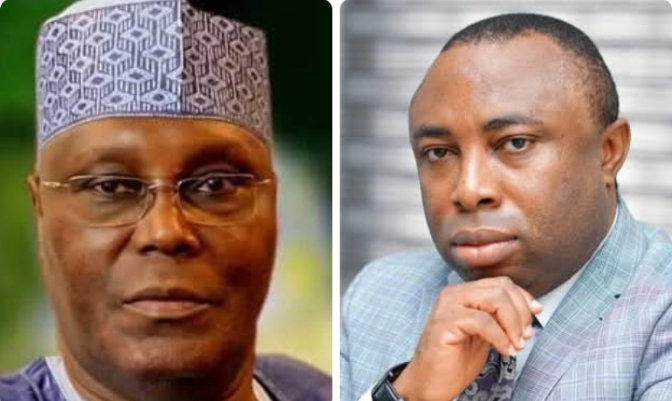

In Nigeria’s evolving electoral landscape, few political figures have maintained as persistent and polarizing a presence as Atiku Abubakar. His decades-long pursuit of the presidency has shaped not only his personal political trajectory but also, increasingly, the dynamics of opposition politics itself. Yet, a critical, data-driven examination of his electoral history, coalition behavior, and strategic positioning suggests a paradox: Atiku’s continued insistence on leading the opposition may be inadvertently consolidating the path to re-election for Bola Ahmed Tinubu in 2027.

Atiku’s political career reflects remarkable persistence, but also a pattern that raises legitimate questions about strategic judgment and national alignment. From his time as Vice President (1999–2007) to his repeated presidential bids across multiple platforms—PDP, AC, APC (briefly), and back to PDP—his trajectory has been driven by an unrelenting personal ambition. This ambition, while not inherently illegitimate in democratic politics, becomes problematic when it consistently overrides broader coalition logic, regional balance, and strategic compromise. In Nigeria’s fragile federal arrangement, where informal power rotation between North and South has become a stabilizing convention, Atiku’s repeated bids—particularly against incumbent or emerging southern leadership—have often been interpreted as disruptive rather than unifying.

Historically, Atiku’s electoral interventions have coincided with moments where southern incumbency or succession was politically salient. In 2007, following the presidency of Olusegun Obasanjo, Atiku contested under the Action Congress (AC) after falling out with the ruling PDP establishment. The results are instructive. Running on the AC platform, Atiku secured approximately 2.6 million votes, placing a distant third behind Umaru Musa Yar’Adua of the PDP (about 24.6 million votes) and Muhammadu Buhari of the ANPP (about 6.6 million votes). This outcome is critical because it demonstrates that outside the PDP’s dominant machinery at the time, Atiku’s personal electoral appeal was limited. The PDP brand—not Atiku alone—was the primary vote aggregator during his most competitive outings.
This pattern persisted. In 2019, under the PDP, Atiku polled approximately 11.3 million votes against Buhari’s 15.2 million, reflecting strong party mobilization but insufficient national consolidation. By 2023, his vote share declined further to roughly 6.9 million votes, placing him second behind Tinubu, who secured about 8.8 million votes, while Peter Obi disrupted the traditional two-party dominance with about 6.1 million votes. The trajectory is unmistakable: Atiku’s electoral base is not expanding—it is fragmenting.
A deeper regional analysis further weakens the argument that Atiku commands northern political dominance. While he has historically performed well in parts of the North-East, his inability to consolidate the entire northern voting bloc has been evident. Northern votes have consistently split across candidates, including Buhari, Tinubu, and others, reflecting that Atiku does not possess hegemonic control over northern political aspirations. In fact, the 2023 election revealed a more pluralistic northern voting pattern, undermining the long-held assumption that Atiku represents a singular northern consensus.
Equally significant is the ideological vacuum that characterizes his campaigns. Across multiple election cycles, Atiku’s policy positions—often centered on privatization and economic liberalization—have remained largely unchanged, even as Nigeria’s socio-economic realities have evolved. In a political environment increasingly driven by youth demographics, digital engagement, and demands for systemic reform, his messaging has struggled to resonate as fresh or transformative. He is widely perceived, fairly or not, as part of the entrenched political establishment that many Nigerians are seeking to move beyond.
Age and momentum also factor into the equation. While experience is an asset, electoral politics is ultimately about energy, narrative, and forward-looking vision. Atiku’s repeated candidacies risk creating voter fatigue, particularly among younger voters who constitute a significant and growing portion of the electorate. The absence of a compelling new narrative further compounds this challenge.
The current opposition coalition dynamics amplify these structural weaknesses. Rather than demonstrating the political maturity, sacrifice, and strategic discipline that characterized the formation of the All Progressives Congress (APC) in 2014, the present coalition landscape is fragmented and personality-driven. The 2014 merger that brought together legacy parties and figures—culminating in Buhari’s victory in 2015—was underpinned by a willingness among key actors to subordinate personal ambition to collective strategy. That level of cohesion is conspicuously absent today.
Atiku’s insistence on emerging as a consensus candidate within this fragmented coalition raises legitimate concerns about a potential “spoiler effect.” In political science terms, a spoiler is a candidate whose participation divides opposition votes, thereby benefiting the incumbent. Given the current configuration—multiple opposition figures with overlapping constituencies—Atiku’s candidacy risks splitting votes that might otherwise coalesce around a single challenger. This dynamic, more than any individual campaign strength, could effectively secure Tinubu’s re-election.
In contrast, Tinubu’s political journey reflects long-term strategic patience and coalition-building discipline. From his role in opposition politics during the early 2000s to his central position in the formation of the APC, Tinubu demonstrated an ability to wait for the right political moment while investing in party structure, alliances, and grassroots networks. His eventual emergence as president in 2023 was not accidental; it was the culmination of years of calculated positioning. This strategic depth stands in stark contrast to the reactive and fragmented posture of the current opposition.
The argument that the current presidential tenure “belongs to the South” is not merely rhetorical; it reflects an informal but influential norm within Nigeria’s political system aimed at preserving regional balance and national cohesion. Atiku’s repeated bids in this context risk being interpreted as a disregard for that balancing principle, further complicating his ability to build a broad, cross-regional coalition.
Other figures within the opposition space also face structural limitations. Rotimi Amaechi, for instance, while experienced, operates within a political environment where local dynamics—particularly the influence of Nyesom Wike—significantly constrain his electoral leverage in Rivers State, a key battleground. Such intra-regional rivalries further weaken the opposition’s capacity to present a unified front.
Taken together, these factors—declining vote share, fragmented base, lack of ideological renewal, age-related perception challenges, and coalition disunity—paint a picture of an opposition landscape that is structurally disadvantaged. Atiku’s continued centrality within this landscape, rather than strengthening it, may be reinforcing these disadvantages.
The conclusion, therefore, is not merely speculative but grounded in observable trends: unless there is a fundamental realignment within the opposition—one that prioritizes unity, generational renewal, and strategic compromise—the path to 2027 is already tilting in favor of the incumbent. In this context, Atiku Abubakar’s political trajectory, rather than representing the opposition’s strongest asset, may well be its most significant structural liability.
Mr Chinenye Nwaogu, a public affairs analyst, writes from Abia State, Nigeria.
-
 Politics1 year ago
‘Bishop Onuoha, Iyke Nwoke luring ADC members into signing a document to suspend Abia chairman’-Okwara Agwu
-

 Politics1 year ago
Ex-State Assembly aspirant, Okoh, APC executive members join ADC in Abia
-

 Politics1 year ago
2027: Southeast chieftain, Daniel Ifeanyi Okorie dumps PRP for ADC in Abia
-

 Politics1 year ago
Abia ADC announces LG chairpersons for membership registration pending harmonization
-

 Politics1 year ago
Abia ADC disciplinary committee summons national welfare secretary, Ukandu over alleged misconducts
-

 News1 year ago
Ex-presidential aspirant, Onwusoanya Ezendigbo calls for legislations banning children of public office-holders to seek education, healthcare aboard
-

 Politics11 months ago
Abia chieftain, Emeka Bahadur tasks ADC members on grassroots mobilization
-

 Politics11 months ago
Stalwart, Emeka Bahadur welcomes ADC NWC to Abia on One-day leadership summit