


Opinion
APC PRESIDENTIAL CAMPAIGN LIST: QUESTIONS OVER THE EXCLUSION OF CHIEF ERIC CHINEMEUCHEYA OPAH AND THE POLITICS OF POWER IN ABIA APC

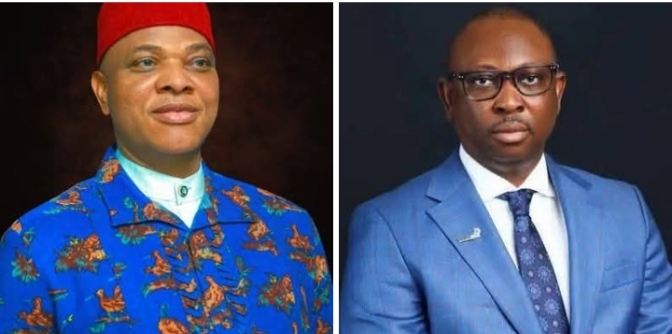

The recent reported changes to the All Progressives Congress (APC) presidential campaign list at the national level have raised important questions about political leadership, internal party democracy, and the distribution of power within the party in Abia State.
At the centre of the controversy is Chief Eric Chinemeucheya Opah, the APC governorship candidate in Abia State, who was reportedly removed as the coordinator of his own campaign structure and replaced by Hon. Chijioke Chukwu, the current State Chairman of the party.

This development deserves more than casual attention. It raises fundamental questions about the relationship between a party’s governorship candidate, its state leadership, and the national structure responsible for coordinating its presidential campaign.
For any reasonable observer, one would naturally expect a governorship candidate to play a central role in coordinating his own campaign and participating in the broader political activities of the party within his state.
This expectation does not mean that a candidate must exercise absolute control over every party structure. Rather, it reflects the need for clear responsibilities, mutual respect, and effective coordination among party stakeholders.
When a governorship candidate is reportedly removed from a campaign leadership position and another party official is appointed in his place, the question that immediately comes to mind is, What informed the decision, and what message does it send to party members and the electorate? These are legitimate questions that deserve clear answers.
Politics is undoubtedly a game of numbers, influence, negotiation, and power. Every political party has its internal dynamics, and the APC is not exempted from these realities.
However, political calculations should not overshadow the principles of fairness, institutional responsibility, and respect for established political processes.
The concern is not necessarily that Hon. Chijioke Chukwu has been appointed to a campaign leadership position. As the State Chairman, he has an important role to play in the party’s activities.
The more significant question is whether the process that produced the reported change was sufficiently transparent and whether the interests of the governorship candidate were adequately considered.
A political party must be able to accommodate different interests without creating the impression that some individuals are being sidelined while others are being elevated.
There is also a broader question about the composition of campaign structures. When individuals who are not candidates on the ballot occupy prominent positions in campaign arrangements, while a major candidate of the same party is reportedly excluded from a key coordination role, party members and observers are entitled to seek clarification.
Political appointments should serve the overall objectives of the party, not become instruments for settling internal scores or demonstrating superiority among competing interests.
Whether intended or not, decisions of this nature can send powerful messages within a political organisation.
To some observers, the reported removal of Chief Eric Chinemeucheya Opah may suggest that other interests within the party have taken precedence over the position of the governorship candidate. Others may interpret it as a routine organisational decision made by the national leadership.
Until the party provides a clear explanation, it would be premature to draw a definitive conclusion about the motives behind the development.
Nevertheless, the APC leadership should recognise that political decisions are rarely interpreted in isolation.
They are assessed against the background of existing relationships, ambitions, disagreements, and expectations among party stakeholders.
If the intention is to strengthen the APC in Abia State, the party must ensure that its decisions promote unity rather than deepen existing divisions.
A party preparing for elections needs the cooperation of its candidates, elected officials, party executives, grassroots mobilisers, and supporters.
No single individual or group can successfully build a broad political structure while disregarding the legitimate concerns of other stakeholders.
There is another important dimension to this unfolding situation: the long-term implications of today’s political decisions.
In politics, today’s decisions often influence tomorrow’s relationships. Those who exercise power today must remember that political fortunes can change, alliances can shift, and circumstances can place people in positions where they, too, require the understanding and support of others.
For those already thinking about their political ambitions for 2031, the events unfolding today should offer an opportunity for reflection.
Political strength is not measured solely by the ability to influence appointments, control structures, or determine who occupies a particular position.
It is also demonstrated through the ability to build trust, respect due process, manage disagreements, and create an environment in which different interests can coexist.
Those who believe that the manipulation or circumvention of established processes will automatically strengthen their political position should pause and reconsider their assumptions.
As a matter of faith, we must also remember that human beings may make plans, but the ultimate outcome of those plans is not entirely within their control.
As Scripture reminds us in Psalm 75:6–7, promotion does not ultimately come from the east or the west; God is the Judge who brings one down and lifts another up.
Political ambition is legitimate, but it should be pursued with humility, wisdom, and a proper understanding of the limits of human power.
The person whose interests are overlooked today may be the person whose cooperation becomes important tomorrow.
For the APC as a political party, this is an opportunity to demonstrate that internal disagreements can be handled with maturity and sincerity of purpose.
The national leadership should clarify the circumstances surrounding the reported change in the campaign list, the responsibilities assigned to the affected officials, and the place of the Abia governorship candidate within the party’s broader campaign structure.
If the decision was informed by strategic considerations, those considerations should be communicated in a manner that promotes understanding.
If there are internal disagreements, the party should create room for dialogue rather than allow speculation to dominate public discussion.
The objective should not be to embarrass any individual or diminish the position of the State Chairman. Both the governorship candidate and the state party leadership have roles to play in building a functional political organisation.
What matters is the need for a structure that respects institutional responsibilities, encourages cooperation, and gives every relevant stakeholder a clear understanding of their role.
The APC must also recognise the importance of public perception. Political parties do not operate in a vacuum.
Their decisions are observed by supporters, opponents, undecided voters, and members of the wider public.
When questions arise about the treatment of a party’s own governorship candidate, silence may leave room for interpretations that the leadership could otherwise address through timely clarification.
The party should therefore approach this matter with the seriousness it deserves.
In politics, not every disagreement is announced publicly, and not every decision reveals the full story behind it. However, political observers are often attentive to the signals conveyed by appointments, removals, and changes in the distribution of responsibilities.
The reported exclusion of Chief Eric Chinemeucheya Opah from the coordination of his own campaign, if accurately represented, is one such development that deserves explanation.
It is important to distinguish between legitimate party reorganisation and decisions that may be perceived as marginalising particular stakeholders.
The former can strengthen a political organisation; the latter, if poorly managed, can generate mistrust and unnecessary division.
The APC must not allow internal political calculations to overshadow the broader objective of building a united and credible party structure in Abia State.
Chief Eric Chinemeucheya Opah’s political journey should be assessed through the democratic process, the support he receives, his engagement with the electorate, and the issues he presents to the people of Abia State.
The same standard of fairness and accountability should apply to every other party stakeholder.
Ultimately, the electorate will judge political actors not only by their internal party arrangements but also by their conduct, their ideas, and their commitment to the public interest.
The unfolding situation presents the APC with a choice: address the concerns transparently and strengthen internal cooperation, or allow unanswered questions to fuel speculation about the balance of power within the party.
This is not a call for confrontation. It is a call for fairness, clarity, and respect for the political process.
Chief Eric Chinemeucheya Opah, Hon. Chijioke Chukwu, and the APC national leadership all have important roles to play in ensuring that the party’s political arrangements are understood and that its structures work towards a common objective.
The party should remember that political power comes with responsibility, and leadership is best demonstrated not merely by the ability to make decisions but by the willingness to explain them, build consensus, and treat stakeholders fairly.
As for the political calculations surrounding 2027 and the ambitions already taking shape for 2031, time will reveal how today’s decisions influence tomorrow’s relationships.
For now, the APC should put its house in order, address the concerns surrounding the campaign list, and ensure that internal arrangements do not become a distraction from its engagement with the people of Abia State.
In politics, the music never stops; the players and the rhythm simply change.
Let the music play on.
Ogu, Okechukwu Charles, Ph.D., is a public affairs analyst and writes from Umuahia, the capital city of Abia State.*
-

 Politics1 year ago
Ex-State Assembly aspirant, Okoh, APC executive members join ADC in Abia
-
 Politics1 year ago
‘Bishop Onuoha, Iyke Nwoke luring ADC members into signing a document to suspend Abia chairman’-Okwara Agwu
-

 Politics1 year ago
2027: Southeast chieftain, Daniel Ifeanyi Okorie dumps PRP for ADC in Abia
-

 News1 year ago
Ex-presidential aspirant, Onwusoanya Ezendigbo calls for legislations banning children of public office-holders to seek education, healthcare aboard
-

 Politics1 year ago
Abia ADC announces LG chairpersons for membership registration pending harmonization
-

 Politics1 year ago
Abia ADC disciplinary committee summons national welfare secretary, Ukandu over alleged misconducts
-

 Politics1 year ago
Abia chieftain, Emeka Bahadur tasks ADC members on grassroots mobilization
-

 Politics1 year ago
Stalwart, Emeka Bahadur welcomes ADC NWC to Abia on One-day leadership summit