
Opinion
Joachim Okhai: The War-Economy: The Conflict-Profit Cartel: When War Becomes Business and Peace Becomes Threat: A Clarion Call to President Tinubu

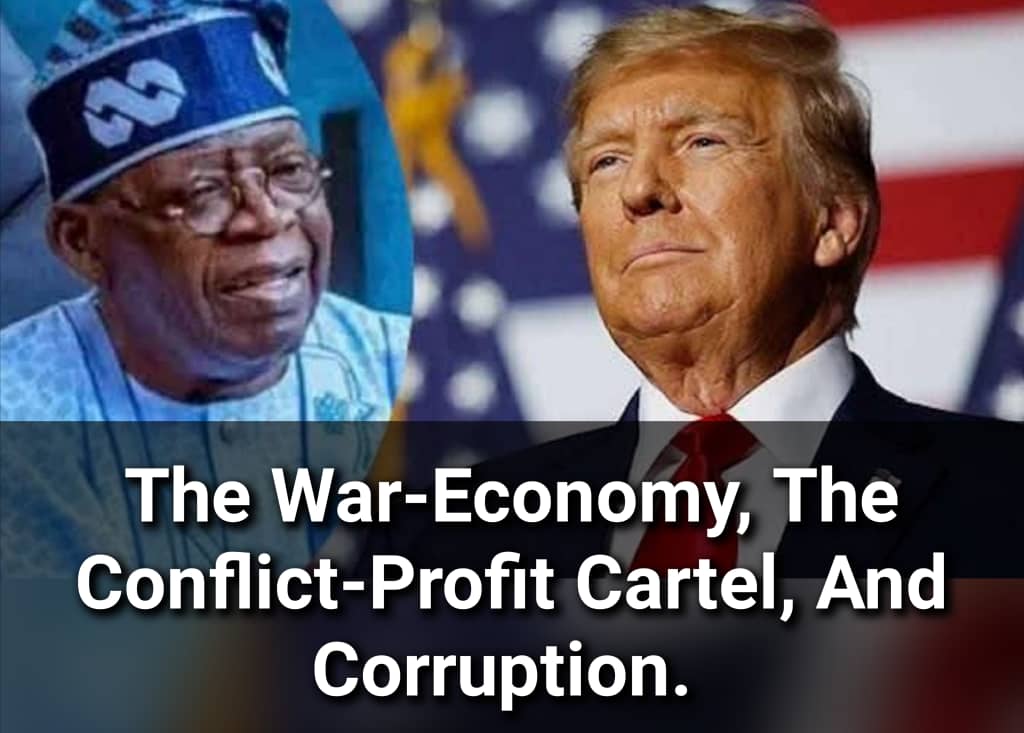

“When the goat thief is contracted to find the stolen goat, there are chances that the goat will never be found.” ~ African proverb.*
Mr. President, President Bola Tinubu, it is time for us speak boldly – honestly – as one true Nigerian patriot to another. Beyond the headlines about the US CPC Act which comes under the International Religious Freedom Act of 1998 (IRFA) of the United States, and the major external warnings from U.S. President, Donald Trump, there lies a far deeper, more corrosive wound in our land: a war-economy that has metastasized in our troubled North-East, North-West and North-Central; an economy in which our National budget defense budget, military budgets, overlapping security votes, contract middle-men, vested interests and insurgency-linked profiteers have enriched themselves at the cost of thousands of Nigerian lives which have been wasted thus far.

The persistent war-economy in Nigeria has inadvertently birthed hidden profiteers. From the onset of the terrorist-insurgency 15 years ago – chiefly driven by Boko Haram and its affiliates in the North-East – our brave men and women in uniform have fought and died. Yet the conflict has also created a structure of profits: not just for militants, but for the shadowy infrastructure of war.
It may be a matter of interest to inform you of the rigorous review of literature on the North-East war-economy states. The conflict with Boko Haram provides an opportunity to interrogate long-standing theoretical assumptions about the economic consequences of violent conflict. This highlights how the war economy involve how people are attracted to the organisation, the opportunities for personal enrichment available in the conflict.
One white paper concluded that: “The crisis supports a war-economy that is gainful to the group as well as to some corrupt public officials in the government.”
In other words, the islamic insurgency in Nigeria has become a business model. Shell companies, phantom and over invoiced contracts, inflated logistics, “security” procurement that never delivers, and layers of middlemen between Abuja, Maiduguri and the field.
Even as thousands die, entire supply-chains of procurement and payments continue to benefit those with political or military connections, while operations falter and civilians suffer. For example: one study found that despite substantial defence spending in the North-East, “much work remains to be done” due to corruption eating deep into the military hierarchy.
Why this matters now is because we have heard of the CPC Act: how the United States tightening its commerce-and‐governance rules, and Nigeria being reminded of its place in the global economy. But the war-economy is our internal CPC – our corruption procurement circle – that is far more urgent.
When war becomes profitable for some, then many shall actively resist peace. They benefit from insecurity. They do not want the insurgency to end – because fewer bullets, fewer trucks hauling (security provisions), fewer contracts for ‘internally displaced persons logistic support’, fewer opportunities for illicit enrichment. Thus, the war-economy becomes self-serving, self-perpetuating.
Meanwhile, the economy suffers massive loss of potential growth. A study found that insurgency and political risk have depressed foreign direct investment in Nigeria’s key sectors.
Communities in the North-Central and North-West live with chronic insecurity. Farmer/herder conflict, banditry, kidnapping – all feed into similar rent-seeking systems.
The human cost is incalculable: thousands dead, millions displaced, children out of school. Aid has been cut. Hunger is rising in conflict-affected areas.
Mr. President, I am making clarion call to you:
Sir, address the CPC Act, by all means. But do not let that distract you from the parallel, unofficial CPC within especially persons of particular interest fueling these crisis: the “Conflict-Profit Corridor” that lines the pockets of politicians, generals, contractors, local elites – and weakens Nigeria’s very fabric.
You must toughen your spine. Do not allow the fear of political fallout – or the inertia of entrenched interests – to stand in your way in doing the needful.
Here are a few of my recommended decisive actions that you should take: Audit all security-votes, war-contracts, procurement-chains in insurgency-affected zones. Publish them. Make them transparent.
Suspend directors, commanders, contractors with unaccountable war-payments. Let Nigeria see prosecutions.
Re-channel funds from war profiteering into reconstruction, education, socioeconomic rebuilding in North-East, North-West, North-Central. The studies show that more prudent allocation of defense-spending coupled with development reduces casualties.
Claw back profiteering networks by breaking the link between insecurity and enrichment. Show that war will no longer pay.
Mobilise civil society and media oversight in conflict zones. The people must see the money flow and the results that flow from the money.
Also, let’s not shy away from the truth that corruption is Nigeria’s major cancer. This is to say, as you deal with the war-economy, you must also fight the cancer of corruption. As one Nigerian scholar put it: “Corruption is one of the most important problems which the people of Nigeria have to tackle and overcome if they are to make any significant and sustainable progress in the 21st century.”
Mr. President, you have said you will fight corruption and restore trust. But trust is being eroded daily as empty promises stack up while war-contracts, procurements and security-votes still vanish into dark corridors.
As I conclude, Let me advise that your positive legacy, Mr. President, should exemplify a nation that does not allow a war-economy to flourish while asking its youth to fight and die is a nation that betrays its highest calling. A leader who watches war proliferate while his officials profit is a leader complicit – by act or by omission.
If you crush the war-economy, you not only save thousands of lives – you restore hope; you open our soil for investments again; you reassure the world that Nigeria is serious. If you leave it unchecked, you hand our country over to both the insurgents and the rent-seekers.
And to those profiteers letting bombs fall and bullets fly because it pays them – consider this your warning: the country sees you. The people will remember. History will judge you.
Finally, Mr. President, address CPC. By all means. But never forget that the greatest CPC you confront is the Conflict-Profit-Complex inside our own borders – where insecurity is currency, and war becomes business. Tackle the war-economy first. Then address corruption overtly, visibly, unrelentingly.
There is no greater service you can render Nigeria than to make it clear: war will not enrich you; insecurity will not pay your bills; the blood of innocents will not fill your coffers.
Mr. President, the hour is late – but the moment is now. For Nigeria, for our children, for our future – let the reckoning begin.
May God bless Federal Republic of Nigeria
Joachim Okhai, a public affairs analyst, writes from Nigeria.
-
 Politics1 year ago
‘Bishop Onuoha, Iyke Nwoke luring ADC members into signing a document to suspend Abia chairman’-Okwara Agwu
-

 Politics1 year ago
Ex-State Assembly aspirant, Okoh, APC executive members join ADC in Abia
-

 Politics1 year ago
2027: Southeast chieftain, Daniel Ifeanyi Okorie dumps PRP for ADC in Abia
-

 Politics1 year ago
Abia ADC announces LG chairpersons for membership registration pending harmonization
-

 Politics1 year ago
Abia ADC disciplinary committee summons national welfare secretary, Ukandu over alleged misconducts
-

 News1 year ago
Ex-presidential aspirant, Onwusoanya Ezendigbo calls for legislations banning children of public office-holders to seek education, healthcare aboard
-

 Politics11 months ago
Abia chieftain, Emeka Bahadur tasks ADC members on grassroots mobilization
-

 Politics11 months ago
Stalwart, Emeka Bahadur welcomes ADC NWC to Abia on One-day leadership summit